
Universities in Malaysia: The Ultimate 2026 Guide for International Students (Rankings, Fees, Programs, Admission & More)
This 2026 guide helps international students understand universities in Malaysia by explaining:
- How the Malaysian higher education system works (public, private, and international universities)
- Key differences in rankings, fees, and program structures
- Admission requirements and step-by-step application process
- Study pathways, intake timelines, and student visa basics
- How to compare universities based on budget, goals, and accreditation (MQA)
Updated for 2026 to support confident, well-informed study decisions.

Thinking about studying abroad, but not sure which university is the right fit for you?
If you are looking for internationally recognised degrees, modern campuses, and more manageable tuition fees compared to many Western countries, universities in Malaysia are worth serious consideration.
Today, Malaysian universities host students from more than 160 countries and offer study pathways in fields such as medicine, engineering, business, IT, design, and hospitality.
With strong government regulation, improving global rankings, and a mix of public, private, and international branch campuses, Malaysia has become a practical and increasingly popular option for international students.
Yet, for many students, the challenge is understanding the differences between universities, academic pathways, and what truly matters when choosing the right institution.
This guide breaks that complexity down step by step.
Why Are Students Choosing Malaysian Universities?
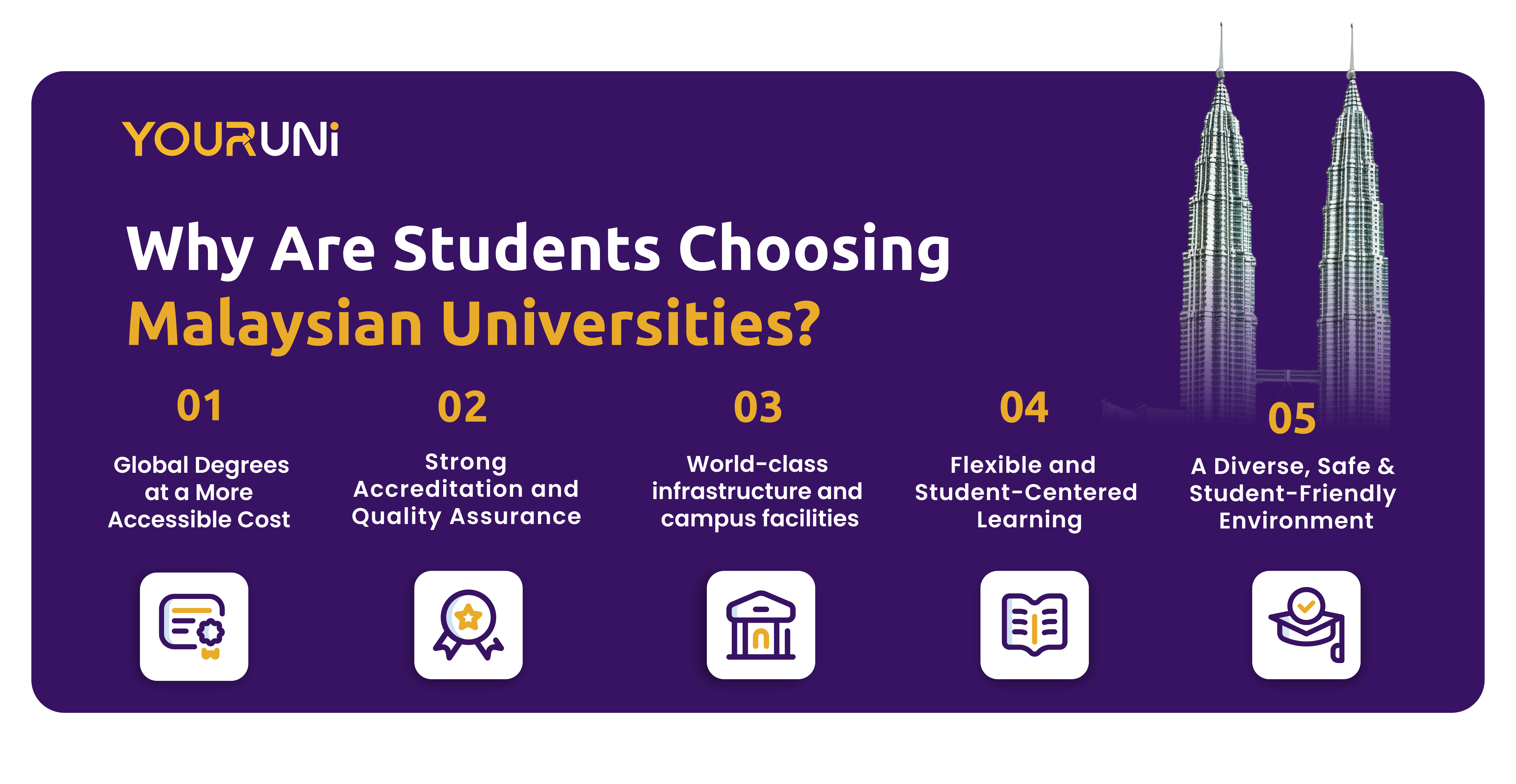
Over the past few years, Malaysian universities have become a serious option for many international students.
Here are some of the main reasons behind this growing interest:
1. Global Degrees at a More Accessible Cost
Many Malaysian universities partner with top institutions in the UK, Australia, and beyond.
Through twinning and dual-degree programs, you can:
-
- Start your degree in Malaysia.
- Study part or all of your program at a partner university abroad.
- Graduate with a globally recognized qualification at a much lower overall cost.
Instead of paying full Western tuition and living costs, you benefit from Asian affordability with Western recognition.
đź’ˇ On average, According to StudyMalaysia,students save between USD 25,000–32,000 compared to studying in Western countries.
2. Strong Accreditation and Quality Assurance
Behind every reputable Malaysian university stand two key bodies:
-
- MOHE (Ministry of Higher Education): sets national higher education policies.
- MQA (Malaysian Qualifications Agency): ensures programs meet strict international standards.
Accreditation here isn’t just a formality, it guarantees that your degree is globally recognized and meets real-world skill requirements.
Many universities also hold international accreditations like:
-
- Washington Accord (Engineering).
- AACSB (Business & Management).
- Professional boards like BEM (Board of Engineers Malaysia)
Malaysia also maintains a strong presence in the QS and Times Higher Education rankings, reflecting its commitment to quality, research, and global academic reputation.
đź’ˇ Pro tip: Always verify your university’s status on the official MQA portal before applying.
3. World-class infrastructure and campus facilities
Malaysia has invested heavily in higher-education infrastructure. On many campuses, you’ll find:
-
- Modern campuses: Well-designed academic buildings, comfortable lecture halls, and widespread use of digital learning tools.
- Advanced labs and facilities: Well-equipped laboratories for engineering, IT, health sciences and other fields, allowing students to practise, not just study theory.
- Strong sports and recreational facilities: Gyms, courts, and sometimes Olympic-sized pools, plus student lounges and green spaces.
Students are not only choosing a degree in Malaysia, they are choosing a modern, well-supported campus environment that supports both academic success and personal growth.
4. Flexible and Student-Centered Learning
From medicine and engineering to business, design and AI, Malaysian universities offer programs for almost every ambition.
Features include:
-
- Multiple intakes per year (especially in private universities),
- Online portals for applications and documents,
- Options to transfer credits to partner universities abroad.
This flexibility allows you to build your study path with less stress and more freedom.
5. A Diverse, Safe & Student-Friendly Environment
Malaysia is consistently ranked as one of Asia’s safest and most welcoming countries and this is reflected on campus and beyond.
Most universities host students from 160+ nationalities, making it easy to adapt, connect, and feel at home.
Inside and outside the university, you’ll benefit from:
-
- A multicultural society where English is widely spoken.
- Affordable living costs, especially compared to the UK, US, and Australia.
- A rich cultural and food scene that makes daily life enjoyable.
- Safe, well-connected cities with modern public transport.
- A vibrant student community with festivals, events, and global friendships.
- Dedicated international-student support services that help you adapt smoothly.
It’s not just a place to study, it’s a place where students grow, explore, and thrive.
Disadvantages of Studying In Malaysia (Things to Consider)

While Malaysian universities offer many advantages, it is also important to understand some of the limitations and challenges.
Knowing both sides will help you make a more realistic and confident decision.
-
Limited Work Hours During Study
International students in Malaysia can usually work part-time only:
-
- During semester breaks or official holidays.
- For a limited number of hours.
- In selected sectors such as hospitality.
This can help with some day-to-day expenses, but it is not enough to fully cover tuition fees or all living costs.
You will still need stable financial support from family, sponsors, or scholarships.
-
Highly Competitive Public Universities
Public universities in Malaysia offer very affordable tuition and strong academic reputations, but:
-
- International admissions are limited.
- Competition is high, especially for undergraduate programmes.
- Priority often goes to local students.
For this reason, many international students end up studying at private universities or international branch campuses.
-
Permanent Residency Is Not Automatic
Unlike countries such as Canada or Australia, Malaysia does not currently offer direct post-study immigration pathways.
-
- Most graduates who wish to stay in Malaysia need to secure a job offer and obtain a work visa through employer sponsorship or a specific pass.
- Long-term stay depends on job opportunities, sector, and current immigration policies.
This does not mean it is impossible to work or stay in Malaysia after graduation, but it is important for students not to assume that studying in Malaysia automatically leads to long-term residency.
Top Universities in Malaysia for International Students
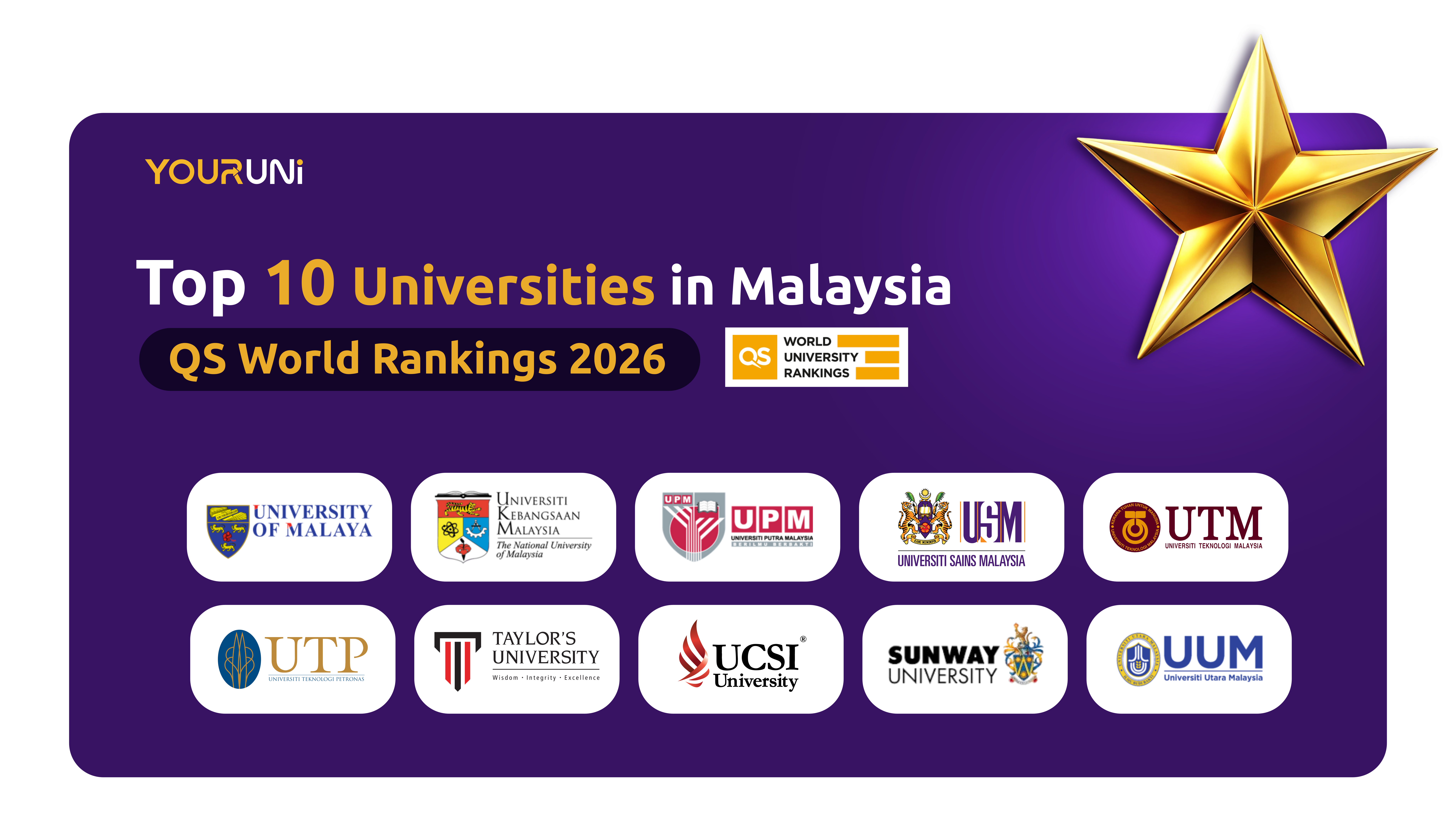
Looking for a university with a strong reputation is a great start.
But choosing the right university is more than just rankings or big names.
The real questions to ask are:
- Does this university offer the program I’m passionate about?
- Will its academic environment help me grow and succeed?
- Can it open doors to a global career after graduation?
In Malaysia, you don’t just find institutions, you find different types of opportunities, depending on the kind of university you choose.
đź’ˇDid you Know: How Many Universities Are in Malaysia?
According to the Ministry of Higher Education (2024):
- 20 Public Universities
- 64 Private Universities
- 11 Foreign University Branch Campuses
This variety allows students to choose based on cost, program quality, and global recognition.
To make your choice easier, we’ll break down Malaysian universities by:
- Type (public, private, semi-government, foreign).
- Cost (affordable vs. high-cost).
- Location (major student cities).
So you can find the one that fits your goals perfectly.
Most Famous Malaysian Universities in Malaysia by Type:
Malaysia is home to over 90 higher education institutions, each with its own unique character:
-
- Government-funded & relatively affordable.
- Focused on academic learning and research.
- Ideal for students seeking solid academic foundations at lower costs.
-
- More flexible in admissions & modern in facilities.
- Offering emerging fields like Artificial Intelligence, Data Analytics, Game Management.
- Known for interactive and industry-relevant teaching.
-
Government-Linked Universities (GLUs):
- Owned or strongly supported by major national corporations.
- Example sectors: oil & gas, electricity, telecommunications, industrial technology.
- Strong industry partnerships, creating excellent internship and employment pathways.
-
International Branch Campuses:
- Campuses of well-known universities from the UK, Australia, China, Ireland, etc.
- Same degree and academic standards as home campus.
- Significantly lower tuition and living costs compared to studying in the original country.
Below are some of the most recognized universities in each category.
Top 10 Public Universities in Malaysia (QS 2026)
|
Unique Highlightings |
Annual Tuition Fees (USD) |
QS 2026 Ranking |
University |
|
3,268 to 8,313 |
58 |
Universiti Malaya (UM) |
|
1,700 to 5,500 |
126 |
Universiti Kebangsaan Malaysia (UKM) |
|
3,000 to 5,000 |
134 |
Universiti Putra Malaysia (UPM) |
|
3,000 to 9,000 |
134 |
Universiti Sains Malaysia (USM) |
|
2,766 to 4,700 |
153 |
Universiti Teknologi Malaysia (UTM) |
|
2,000 to 3,500 |
491 |
Universiti Utara Malaysia (UUM) |
|
4,000 to 10,000 |
542 |
Universiti Teknologi MARA (UiTM) |
|
7,500 to 12,000 |
609 |
Universiti Malaysia Pahang Al-Sultan Abdullah (UMPSA) |
|
3,000 to 6,800 |
613 |
International Islamic University Malaysia (IIUM) |
|
2,500 to 4,750 |
801-850 |
Universiti Malaysia Terengganu (UMT) |
Top 10 Private Universities in Malaysia (QS 2026)
|
Unique Highlighting |
Annual Tuition Fees (USD) |
QS 2026 Ranking |
University |
|
8,810 - 22,932 |
253 |
Taylor’s University |
|
5,128 - 11,157 |
269 |
UCSI University |
|
4,560 - 10,650 |
410 |
|
|
4,474 - 7,391 |
509 |
|
|
5,200 - 8,725 |
597 |
Asia Pacific University of Technology & Innovation (APU) |
|
4,417 - 14,000 |
597 |
Management & Science University (MSU) |
|
3,167 - 4,084 |
638 |
|
|
4,627 - 7,150 |
731-740 |
SEGi UNIVERSITY |
|
3,913 - 5,783 |
791-800 |
Universiti Tunku Abdul Rahman (UTAR) |
|
3,500 - 7,144 |
951-1000 |
University of Cyberjaya |
đź’ˇNote: Private universities are very popular among international students due to English-medium programs, multiple intakes, and flexible admission pathways.
Semi Government Universities (QS 2026)
|
Unique Highlighting |
Annual Tuition Fees (USD) |
QS 2026 Ranking |
University |
|
4,838 - 7,219 |
251 |
Universiti Teknologi Petronas (UTP) |
|
5,313 - 6,500 |
551 |
Universiti Tenaga Nasional (UNITEN) |
|
5,604 - 6550 |
851-900 |
Multimedia University (MMU) |
|
4,400 - 9,750 |
1201-1400 |
Universiti Kuala Lumpur (UniKL) |
Foreign University Branch Campuses in Malaysia (QS 2026)
|
Unique Highlighting |
Country of Origin |
QS 2026 Ranking |
University |
|
Australia |
36 |
|
|
183 |
||
|
294 |
Swinburne University of Technology | |
|
UK |
87 |
University of Southampton |
|
97 |
University of Nottingham | |
|
287 |
Heriot-Watt University | |
|
194 |
University of Reading |
|
|
137 |
Newcastle University Medicine (NUMed) | |
|
China |
341 |
Xiamen University |
|
Ireland |
118 |
(RUMC) or RCSI & UCD Malaysia (Royal College of Surgeons in Ireland & University College Dublin) |
đź’ˇWant to explore each university in more detail? Check our University Database for comprehensive profiles of all Malaysian universities.
Most Famous Universities in Malaysia by Cost:
One of Malaysia’s greatest advantages is its affordable cost of education, maintaining high academic standards and globally recognized degrees.
Still, tuition fees vary depending on the university type, program, and international partnerships.
Here’s a quick breakdown:
1. High-Cost Universities
|
Top Expensive Private Universities |
Annual Tuition Fees (USD) |
|
12,300 |
|
|
Asia Pacific University of Technology & Innovation (APU) |
9,040 |
|
Sunway University |
8,820 |
2. Low-Cost Universities
|
Low-Cost Universities |
Annual Tuition Fees (USD) |
|
City University (City U) |
3,050 |
|
Lincoln University College (LUC) |
2,950 |
3. International Branches: Global Quality at a Lower Cost
|
International Universities in Malaysia |
Tuition Fees in Malaysia per Year (USD) |
Tuition Fees in Home Country per Year (USD) |
|
Monash University Malaysia |
12,480 - 17,760 |
33,061 - 40,884 |
|
University of Nottingham Malaysia |
8,875 - 15,275 |
17,692 - 23,654 |
Most Famous Universities in Malaysia by Location:
Kuala Lumpur, Selangor, Penang, and Johor are the most prominent regions where universities are concentrated.
Each location is characterized by a different environment in terms of lifestyle, cost of living, and available opportunities.
Here’s where you’ll find some of the country’s best universities:
|
Why Choose This Location |
Top Universities |
City/Region |
|
|
|
|
|
|
|
|
|
|
|
|
|
|
|
|
|

Study Modes and Programs in Malaysian Universities

Malaysia’s education system is designed to make things simple and transparent, especially for international students.
Malaysia understands that students learn differently, which is why universities offer flexible study options:
-
Study modes: Full-time, part-time, or online learning.
-
Study levels:
- Foundation & Pre-University.
- Diploma & Certificates.
- Undergraduate Courses (Bachelor’s Degrees).
- Postgraduate Courses (Master’s and PhD programs).
-
Language: English is the main language of instruction in most private and international universities. (Many universities also provide English preparation courses before degree programs to help students transition smoothly.)
A strong feature of Malaysian education is an emphasis on practical learning:
- Many programs include internships or industry training.
- Fields like engineering, IT, hospitality, and business often require mandatory industrial attachment.
- This ensures that graduates leave with both academic knowledge and real-world experience.
(Just make sure to follow your university’s rules and get the right visa for internships.)
What Are the Most In-Demand Courses in Malaysia?

Choosing a course can be tricky.
You’ve probably heard: “Follow your passion” or “Pick a course that’s in demand.”
The truth? You need both: passion and practicality.
Instead of asking “What’s the best course?”, ask yourself:
- What do I enjoy learning?
- What are my strengths and priorities?
- Which path gives me real career options locally and internationally?
Choose a field that excites you, builds real skills, and opens doors to global careers.
Popular Courses in Malaysia
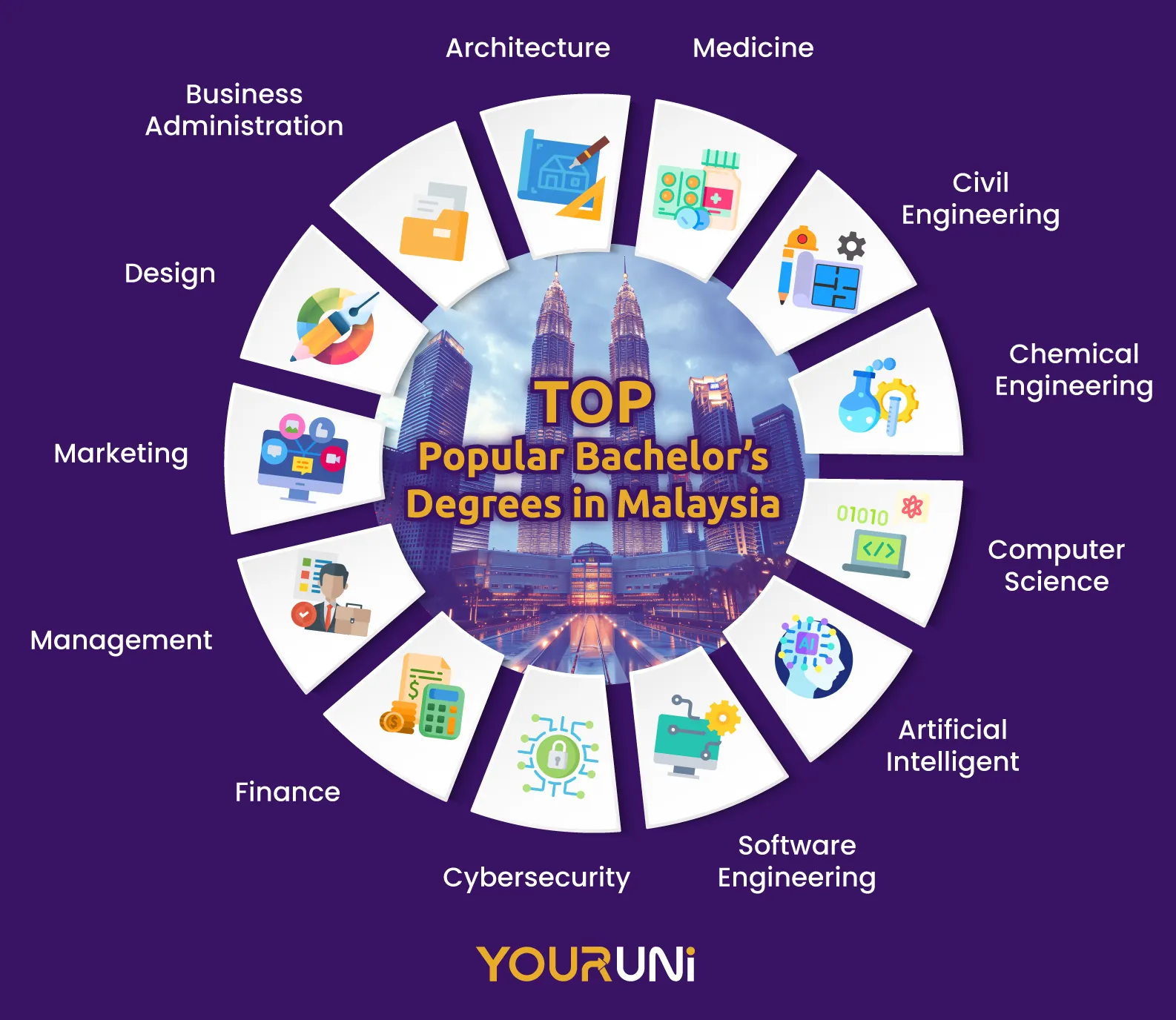
Here are the most in-demand fields, grouped by category:
|
Popular Course |
Field |
|
🖥️Computer Science & IT |
|
|
|
|
đź©ş Health and Medicine |
|
🎨 Arts & Design |
đź’ˇYou can check the list of available courses in Malaysia or visit our website to read more detailed articles about each specialization.
Unique & Emerging Courses in Malaysia
If you’re looking for something different, Malaysia also offers specialized programs such as:
|
Unique Courses in Malaysia |
Focus |
Top University |
|
Green Technology |
Sustainable energy, eco-design, and environmental impact reduction. |
Universiti Teknologi Malaysia (UTM) |
|
Sports Science |
Biomechanics, exercise physiology, and sports psychology. |
Universiti Putra Malaysia (UPM) |
|
Renewable Energy Engineering |
Solar, wind, and other sustainable energy sources. |
Universiti Tenaga Nasional (UNITEN) |
|
Marine Biology |
Ocean ecosystems, marine species, and conservation. |
Universiti Malaysia Terengganu (UMT) |
|
Game Design and Development |
Game creation, interactive media, and digital storytelling. |
Multimedia University (MMU) |
|
Financial Technology (FinTech) |
Blockchain, mobile payments, and financial data. |
Asia Pacific University (APU) |

University Intake Months in Malaysia

When planning your application, it’s crucial to know when you can start.
Here’s a quick overview of the main intake months for Malaysian institutions:
|
University Type |
Main Intake(s) |
What to keep in mind |
|
Public Universities |
March, October |
Competitive admissions |
|
Private Universities |
January, May, September |
More flexibility in admissions |
|
International Branch Campuses |
January, July, September |
May follow home country’s schedule |
|
Colleges |
Multiple throughout the year |
Check directly with your chosen college |
|
Research Mode (Postgraduate) |
Open year-round |
Apply anytime |
đź’ˇ Pro Tip: The best time to apply to Malaysian universities is at least 3 months before the semester begins. This gives you enough time to secure your admission and process your student visa without stress.
How to Choose the Right University in Malaysia

This is where many students feel stuck. With so many good options, how do you decide?
Here’s a simple framework to guide your decision:
1. Start with your program, not the brand name
-
- List your top 1–3 fields of interest (e.g. Computer Science, Business, Mechanical Engineering).
- Look for universities known for strength in those areas, not just overall ranking.
2. Define your budget
-
- Decide what you (or your family) can comfortably afford for tuition and living.
- Compare public vs private vs branch campuses within that budget range.
3. Think about location and lifestyle
-
- Do you prefer a big-city campus in Kuala Lumpur?
- Or a quieter environment in a smaller city?
- Consider lifestyle, culture, transport, and proximity to internships or industries relevant to your field.
4. Check accreditation and recognition
-
- Verify that your program is accredited by MQA and relevant professional bodies.
- If you plan to work in a specific country later, check whether employers or authorities there recognize the degree.
5. Look at graduate outcomes and industry links
-
- Does the university publish data on graduate employment?
- Are there internships, co-op programs, or strong partnerships with companies?
đź’ˇ If you need help evaluating your options, YourUni can provide personalized guidance based on your goals, academic background, and budget.
How to Start Your University Journey in Malaysia

Students often hear one piece of advice: “Apply early.”
And yes, applying early is important.
But timing alone isn’t enough.
What truly makes a difference is choosing the right universities, understanding their requirements, and submitting a complete, accurate application.
As an international student, you have two main options:
- Apply on your own through each university’s official website, or
- Apply with the support of an education agency like YourUni, which helps you compare options and submit strong applications.
đź’ˇ Think of it this way: The right guidance helps you find the right university for you.
How to Apply to Malaysian Universities
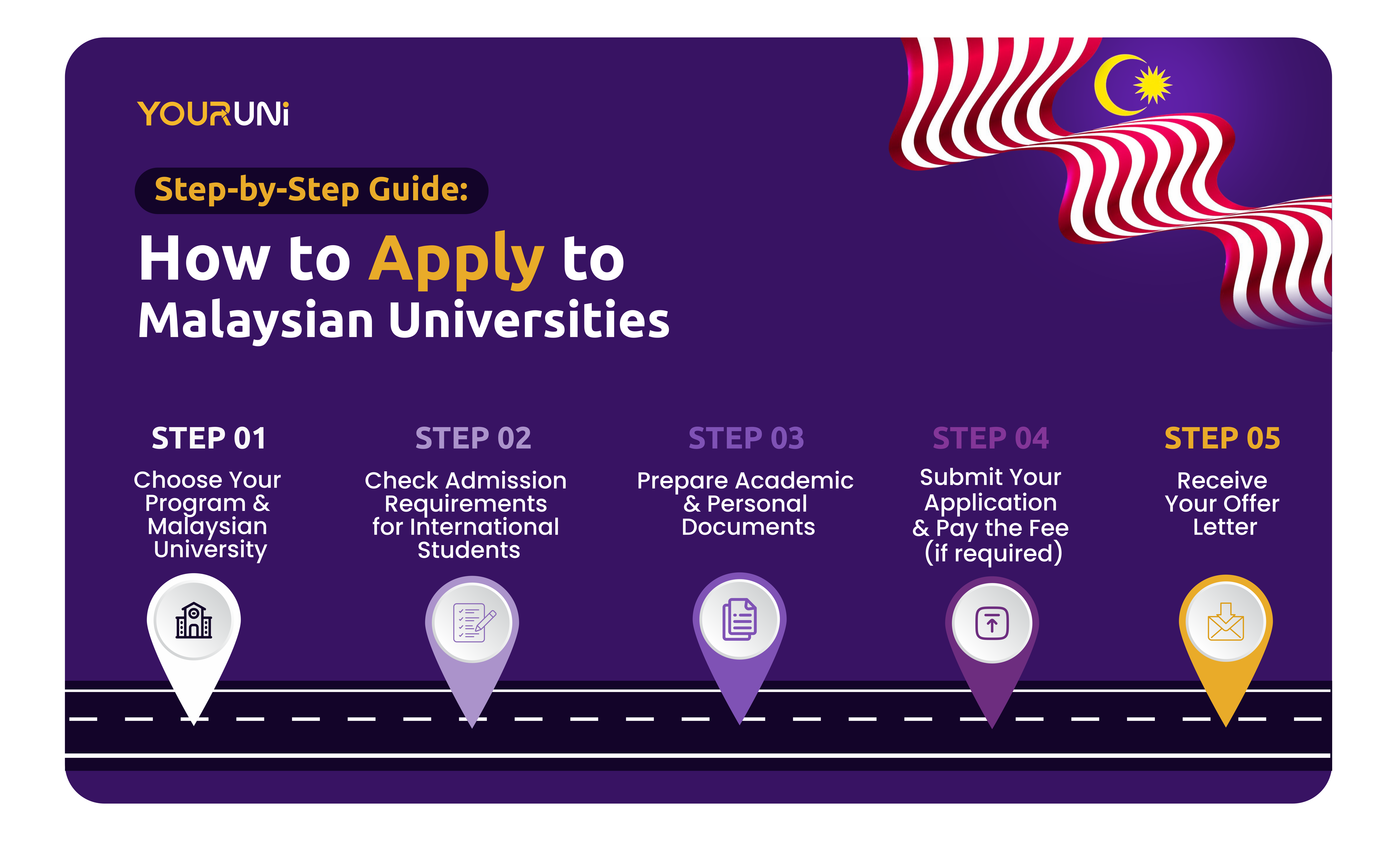
Here’s a simplified overview to the steps to follow for a successful admission:
Step 1: Choose Your Program & Malaysian University
Shortlist universities that match your field of interest, budget, and preferred location.
Step 2:Check Admission Requirements for International Students
For each program, check:
- minimum academic requirements
- English language requirements (IELTS/TOEFL or equivalent)
- any extra conditions (portfolio, interview, work experience, etc.)
Step 3: Prepare Academic & Personal Documents
Make sure all your documents are ready and meet university standards:
- Academic transcripts.
- Passport copy.
- Passport-size photo (white background).
- Other documents (CV, research proposal, recommendation letters) if needed.
đź’ˇ Tip: If your documents are not in English, you may need certified translation.
Step 4: Submit Your Application & Pay the Fee (if required)
Apply your application and pay fees.
đź’ˇNote: Some private universities in Malaysia don’t charge application fees, especially for online submissions.
Step 5: Receive Your Offer Letter
If accepted, you’ll receive an offer letter by email.
Your next step is to confirm your place and move on to the student visa process.
Applying for a Student Visa in Malaysia

To start your studies, you’ll need a Student Visa in Malaysia.
Here’s the process in short:
âś” Prepare your documents
Valid passport, university offer letter, academic documents, photos, and any required English test results.
đź’ˇEnsure you thoroughly review all required documents.
✔Submit Your Student Visa Application
Submit your visa application through Education Malaysia Global Services (EMGS).
âś” Receive your VAL/eVAL
If your application is approved, you’ll get an electronic Visa Approval Letter (eVAL) from EMGS by email.
âś” Apply for eVISA or Entry Visa
Depending on your nationality, you either apply for an eVisa / Entry Visa or may be eligible for Visa on Arrival.
âś” Travel & Final Steps
- Book your flight (to Kuala Lumpur KLIA/KLIA2).
- Keep your documents ready (passport, offer letter, eVAL, eVisa).
- Fill out the Malaysia Digital Arrival Card (MDAC) 3 days before travel.
⚠️ Important notes:
- You can apply for a Malaysia Student Visa in two ways:
- The university can apply for you.
- Or, an education agency (like YourUni) helps you with the process.
- The Student Visa process usually takes 4–6 weeks.
- The student visa fee in Malaysia usually ranges between MYR 2650 and MYR 3850 (approximately USD 662,5 to USD 962,5), depending on your nationality and university.
- Avoid the most common reasons for rejection: missing/inaccurate documents, or not meeting financial/academic requirements.
đź’ˇ For full details, check our Student Visa Guide section.
How Much Does It Cost to Study and Live in Malaysia

Money can sometimes feel like a reason to worry instead of a reason to plan.
You might ask yourself:
How much will I need to study and live in Malaysia? Is Malaysia expensive? Can I actually afford it?
Malaysia is one of the most affordable study destinations in Asia without compromising quality.
Tuition Fees in Malaysian Universities
Here’s an overview of Malaysian University Fees:
|
Type of University |
Tuition Fees Per Year (USD) |
|
Public University |
1,750 to 7,500 (excluding medical programmes) |
|
Private University |
3,200 to 17,000 (excluding medical programmes) |
đź’ˇ Good to Know: Fees may vary depending on your university, course, lab work, admin charges, or other extra costs.
Cost of Living in Malaysia for International Students
The average monthly cost of living in Malaysia for international students, including rent, is RM1,700 - RM2,600 (365 -557 USD).
Despite its affordability, Malaysia ranked 12th in Asia for Numbeo's Quality of Life Index, reflecting a balanced mix of cost efficiency and comfortable living standards.
This usually includes:
- Accommodation (On-Campus vs. Off-Campus).
- Food and Groceries.
- Transport.
- Basic utilities and internet.
- Some personal/leisure expenses.
đź’ˇFor a full breakdown of monthly budgets, and cost comparisons with countries like the Turkey, US, and Australia, read: Study in Malaysia 2026: The Ultimate Roadmap [Costs, Rankings & Visa].
Student Discounts: With your iKad (student card), you’ll enjoy discounts on transport (LRT Student Card), restaurants, and even shopping.
Can International Students Get Scholarships in Malaysia

It’s no secret that in some countries, like Germany or Norway, higher education can be free.
But what about Malaysia? Are there free universities here?
The short answer: No, tuition-free education isn’t common in Malaysia.
But here’s the good news: there are plenty of ways to make your studies much more affordable.
From scholarships and tuition discounts to student exchange programs you have options.
Scholarships & Tuition Waivers
Many Malaysian universities offer scholarships to international students.
These scholarships may include:
- Full tuition fee waiver.
- Partial waiver (discounts).
- Or financial support based on academic excellence or talent.
Examples of Tuition Fee Waivers:
- INTI Tertiary Scholarship – tiered discounts based on CGPA.
- Taylor’s University – merit-based scholarship.
- Sunway University – scholarships for top achievers and financially challenged students.
- HELP University – leadership or talent scholarships and special fee waivers.
đź’ˇVisit the Education Malaysia Global Services (EMGS) official website for updated opportunities.
Student Exchange Programs
If your home university has a partnership with a Malaysian institution (like Universiti Malaya (UM) or Universiti Putra Malaysia (UPM)):
- You can study in Malaysia for a semester or a year without paying extra tuition fees; you only cover your living expenses.
- This is an excellent opportunity to experience Malaysian education for free or at a low cost.
Choosing Your Malaysian University with Confidence

In the end, choosing a university in Malaysia is not just about chasing a ranking table or a famous name.
It’s about making a strategic decision: selecting an institution whose strengths, programs, and environment align with the future you want to build.
Malaysia’s higher education landscape gives you the space to do exactly that.
You have access to serious academic quality, globally recognised degrees, and a diverse range of study pathways, all within one country.
The question is no longer “Are there good universities in Malaysia?”
The real question is: “Which Malaysian university is the right match for me?”
You don’t have to answer that alone.
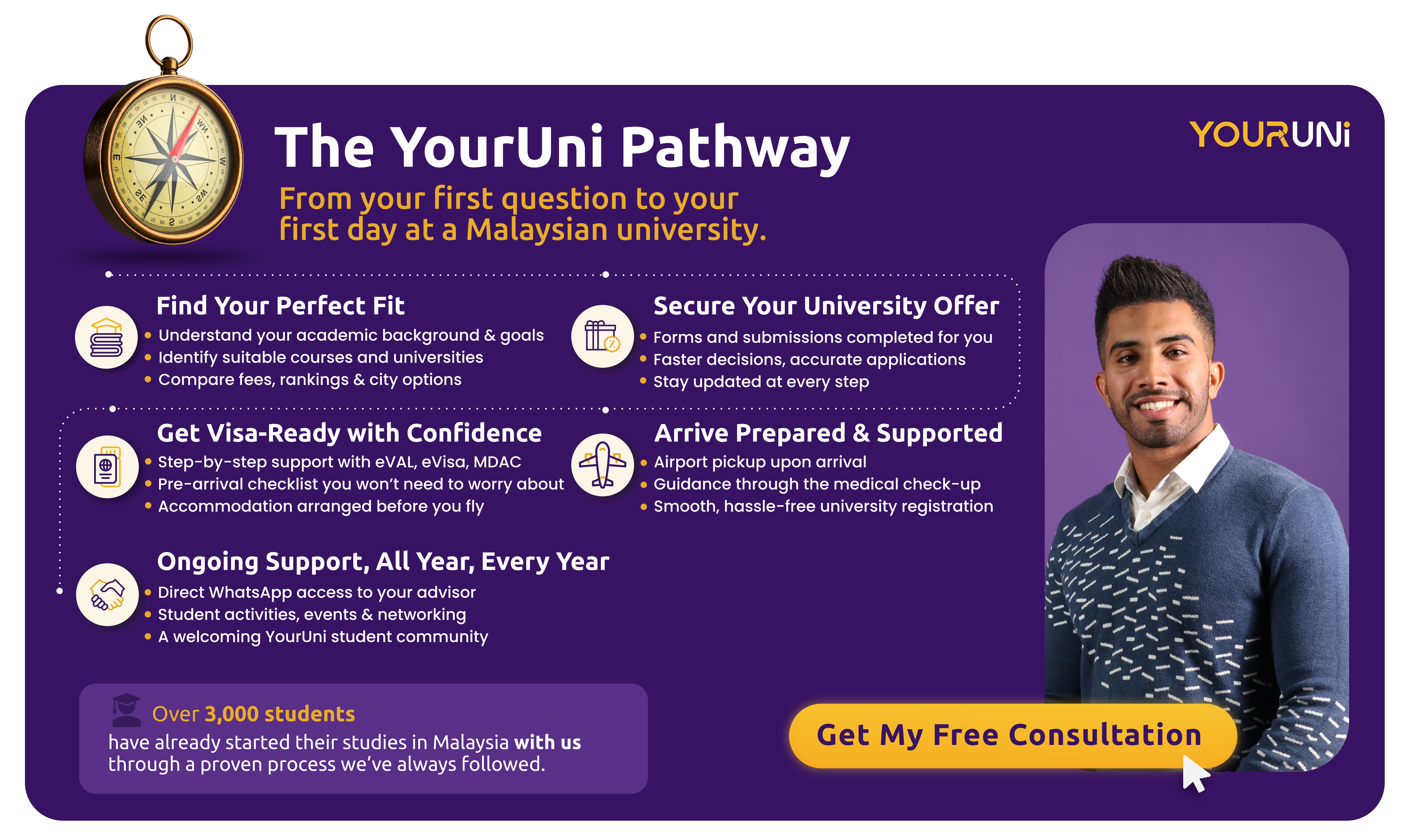
If you need personalized guidance, YourUni team can help you compare universities and understand your options clearly.
FAQ About Studying in Universities in Malaysia
1.Are Malaysian universities good for international students?
Yes! Malaysia is one of the most affordable and welcoming destinations for international students.
You’ll find world-ranked universities, high-quality education, and a multicultural environment that makes it easy to adapt and make friends.
2. What are the top universities in Malaysia for international students?
Some of the most recognized ones include:
- Universiti Malaya (UM)
- Universiti Kebangsaan Malaysia (UKM)
- Universiti Putra Malaysia (UPM)
- Taylor’s University
- UCSI University
- Sunway University
3.How much does it cost to study in Malaysia?
Tuition fees usually range from $2,000 to $17,000 per year, depending on the course and institution.
Living expenses are around USD 365-557 per month, which is much lower than in the UK, US, or Australia.
4.Is Malaysia a safe country for students?
Absolutely. Malaysia is known for its safety, political stability, and friendly locals.
Universities also have strict security and support systems for international students.
5.What are the English requirements for studying in Malaysia?
You’ll typically need an IELTS score of 4.5 – 7.0 or an equivalent English qualification, depending on the program and level of study.
6.Can I Study in Malaysia Without IELTS?
Some universities in Malaysia offer exemptions from IELTS for international students, depending on their native language, or prior educational background in English.
For a full explanation, see Can You Study in Malaysia Without IELTS?
7.How long does it take to complete a degree in Malaysia?
- Bachelor’s Degree: Usually 3 to 4 years (medicine programs may take 5-6 years).
- Master’s Degree: 1 to 2 years.
- PhD: Around 3 to 5 years, depending on research progress.
8.What’s the difference between public and private universities in Malaysia?
- Public universities are government-funded, highly competitive, and generally more affordable.
- Private universities offer flexible intakes, modern facilities, and globally linked programs.
9. Is English widely used at Malaysian universities?
Yes. Many universities – particularly private and international branch campuses – teach most programs in English.
Some institutions also offer pre-sessional English courses for students who need extra language support.
10. Can International Students Work in Malaysia While Studying?
Yes! International students can work part-time under specific conditions (limited hours, certain types of jobs, and usually during semester breaks).
11. Can International Students Work in Malaysia After Graduation?
Yes, international students can work in Malaysia after completing their degree




.webp)

